
Description
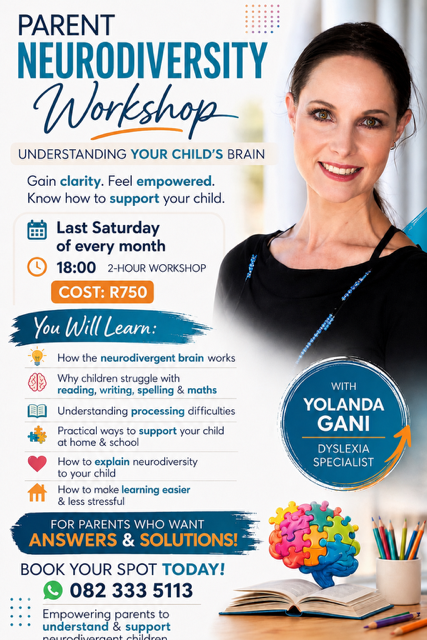
Parent Neurodiversity Session – The Roadmap to Understanding Your Child
27 June 2026: 18:00-20:00 (Monthly sessions on the last Saturday of the month)
Understanding the neurodivergent brain can often feel overwhelming for parents. Many different professionals focus on specific diagnoses and interventions, and each may provide their own recommendations. As a result, parents often receive long lists of suggestions that can feel confusing and difficult to navigate.
I understand this experience personally.
There was a time when I was in the same position as many parents today — trying to understand what was happening with my child, why she struggled at school, and why my experience of my child differed so much from what teachers and professionals were telling me.
At one stage, I was told that my child would never cope in mainstream education. I was advised to lower my expectations and accept that she did not have the cognitive ability for mainstream schooling. This left me deeply confused and searching for answers. She completed grade 7 (mainstream) last year being 2nd in her grade academically with an average of 93,1%. I firmly believe that each and every child can achieve their optimal potential with the correct understanding and support.
During that time, I consulted at least 13 different professionals in an attempt to understand what my child needed. Despite all the assessments and reports, I still felt uncertain and overwhelmed.
Everything changed when I met Dr. Tolmie, a dyslexia specialist (she retired recently).
For the first time, I truly understood dyslexia. I understood what was happening in my child’s brain and why there were so many inconsistencies and frustrations. Suddenly the struggles with reading, writing, spelling and learning made sense.
Today, I have become the person I once needed when I was a confused and desperate parent trying to help my own child.
Over the years I realised that dyslexia and neurodiversity cross many professional disciplines. If all these professionals had been able to sit around one table together, they might have recognised the dyslexia much earlier.
Dyslexia affects processing — how the brain receives, understands and produces information. This includes everything a child hears, sees, says, reads and writes.
In the medical field, these difficulties are often diagnosed as a Specific Learning Disorder (SLD). However, the term “disorder” means the severity must be high enough to meet diagnostic criteria. Many children experience mild or moderate processing difficulties, which may not qualify as a formal diagnosis.
Even without a diagnosis, the brain may still be processing information differently.
This creates a major challenge. Children may struggle with learning, anxiety, and academic tasks, but because they do not meet the threshold for a diagnosis, they often continue in systems that do not fully support their needs.
These children are often capable and intelligent, yet they experience ongoing frustration because their learning profile is not properly understood.
Who Will Benefit From This Session?
This session is for parents who may be experiencing any of the following:
- Your child has a neurodivergent diagnosis
- Your child attends speech therapy or occupational therapy
- Your child requires additional academic support
- A teacher has suggested that your child should be assessed
- Your child struggles with:
- Reading
- Writing
- Spelling
- Comprehension
- Mathematics
(Each child may struggle in different areas.)
- You feel confused by reports and assessments
- You are unsure how your child should study or prepare for exams
- You feel that your child’s learning profile is difficult to understand
If any of these sound familiar, this session is for you.
During This Session We Will Discuss:
- Understanding the neurodivergent brain
- A general overview of different neurodivergent diagnoses
- The core difficulty: processing
- What happens in the brain when children process information
- Why many children struggle with reading, writing, spelling and comprehension
- Why some children struggle with mathematics
- Practical ways to support your child at home
- How to explain neurodiversity to your child in a positive way
(There is nothing “wrong” with them — they simply process information differently.) - Why children may struggle with:
- Instructions
- Procrastination
- Daydreaming
- Inconsistent academic performance
- Anxiety
- Frustration
- Emotional outbursts
- Regression
These behaviours are often part of how the neurodivergent brain functions.
Session Format
This is a 2-hour session where I will explain these topics in detail.
Please remember that every child has a unique profile. Not every aspect discussed will apply to your child. However, the goal is for you to gain a deeper understanding of the areas where your child may be experiencing challenges.
Optional Individual Parent Sessions (30 min @R250)
After attending the session, parents will have the opportunity to book an individual 30-minute consultation with me – with the focus on YOUR child.
During this session I can help you:
- Understand your child’s assessment reports
- Clarify recommendations from professionals
- Develop a personalised support plan for your child
Information on how to book these sessions will be shared with session participants after the event.
My Goal
The goal of this session is to empower parents with knowledge and understanding, so that you feel confident in supporting your child and advocating for their needs.
If you have any questions or concerns, please feel free to contact me.
I look forward to supporting you on this journey.
The cost for an individual session is R3500.
Do you need the X-Pen?
How to order with FREE shipping:
https://www.x-pen.world/?af=
 Click on link and go to [Log In](register)
 Go to ‘My Shop’ to place your order and finalize payment.


Reviews
There are no reviews yet.